
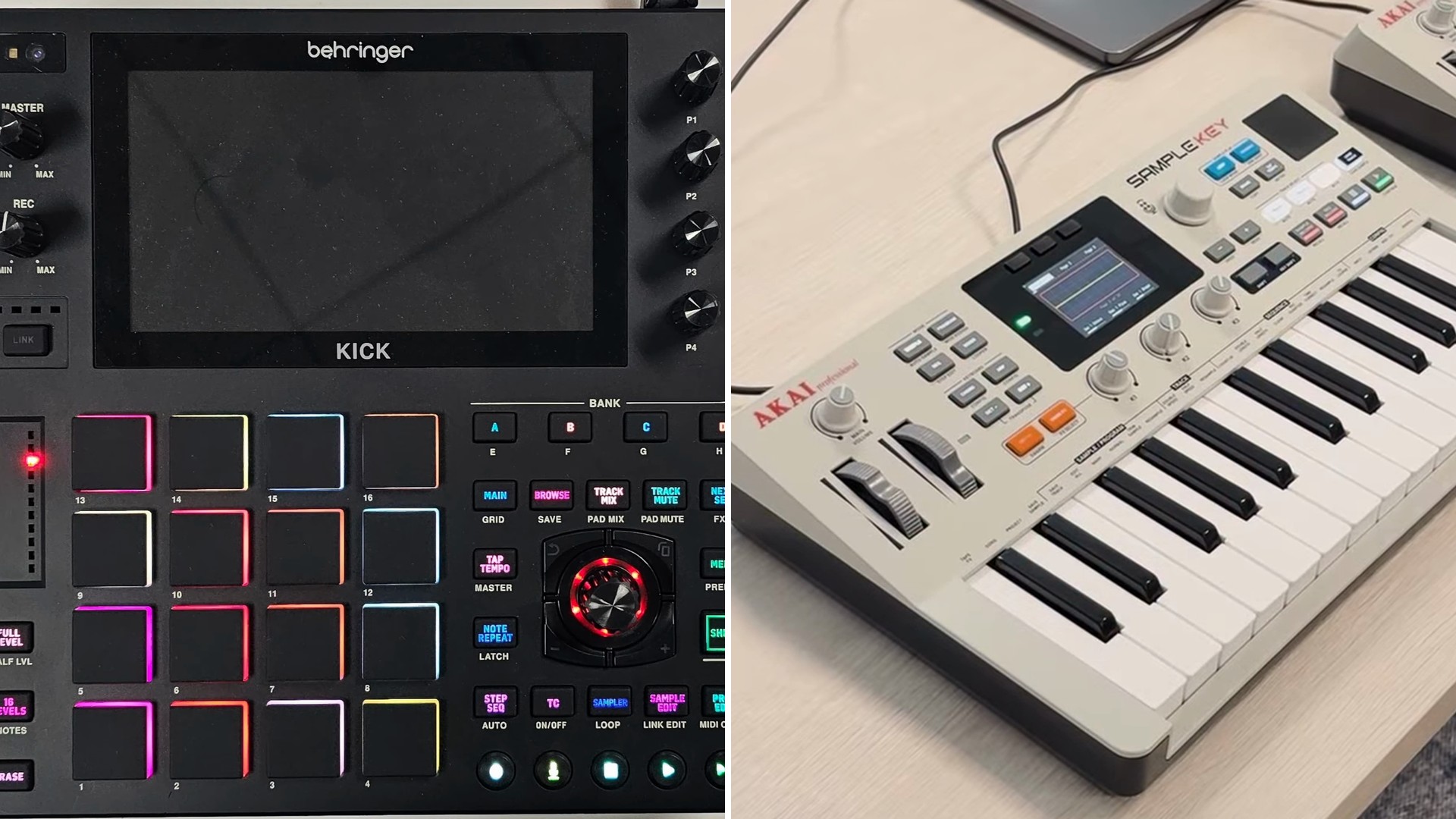
If you’ve been following MPC news these last few days, you’ve definitely seen the Behringer Kick: Behringer has just cloned the MPC One, and it’s giving away the code for its machine for free. The next day, Akai answers with a new machine, the Sample Key, whose firmware you’ll be able to modify. On social media, it’s going in every direction, between real info, rumors and dodgy images.
Since almost everything is covered in English, I watched the videos from Akai and from several American YouTubers, and I cross-checked with what you can find online. I’ll sum up what I understood, sort things out, and above all tell you what it changes (or doesn’t) for your MPC.
Behringer Kick: an open source clone of the MPC One
Behringer’s new machine is called the Kick. A 7-inch touchscreen, 16 RGB pads, 4 knobs, a wheel and a touch strip. If you own an MPC, you can see right away that it looks a lot like the MPC One, and a bit like the MPC Live 3 with the strip. Behringer is the brand that copies everything: Moog, Roland, Oberheim synths. Now it’s the MPC’s turn. I find that pretty bold.
On paper, the Kick is a sampler, a step sequencer and a looper. They announce 300 effects, MIDI, CV and gate outputs to drive synths, and even a camera to control the machine with gestures. The target price: 150 dollars, roughly a fifth of the price of an MPC One according to an American YouTuber. Of course, people are talking.
But the real story isn’t the look. Behringer has put all the machine’s code online, as open source on GitHub, the big code library for developers. At first, a lot of people thought it was AI-generated images, me included. But I checked it myself: the repository exists, and the code is published under a real free license. Anyone can read it, modify it and add their own functions.
Behringer says clearly that with AI, even someone who can’t program will be able to create their own functions. That’s vibe coding: you explain what you want to an AI, and it writes the code. I’m a developer, and I can tell you it’s completely turning the job upside down.
Now, let’s keep a cool head. Right now, the Kick is a prototype. No release date. The 150 dollars is a target, not a store price. And with Behringer, months or even years can go by between a prototype and a machine you can buy. So if you see a video telling you the MPC is dead and you need to sell everything: nothing has come out.
Akai Sample Key: an MPC Sample with a keyboard
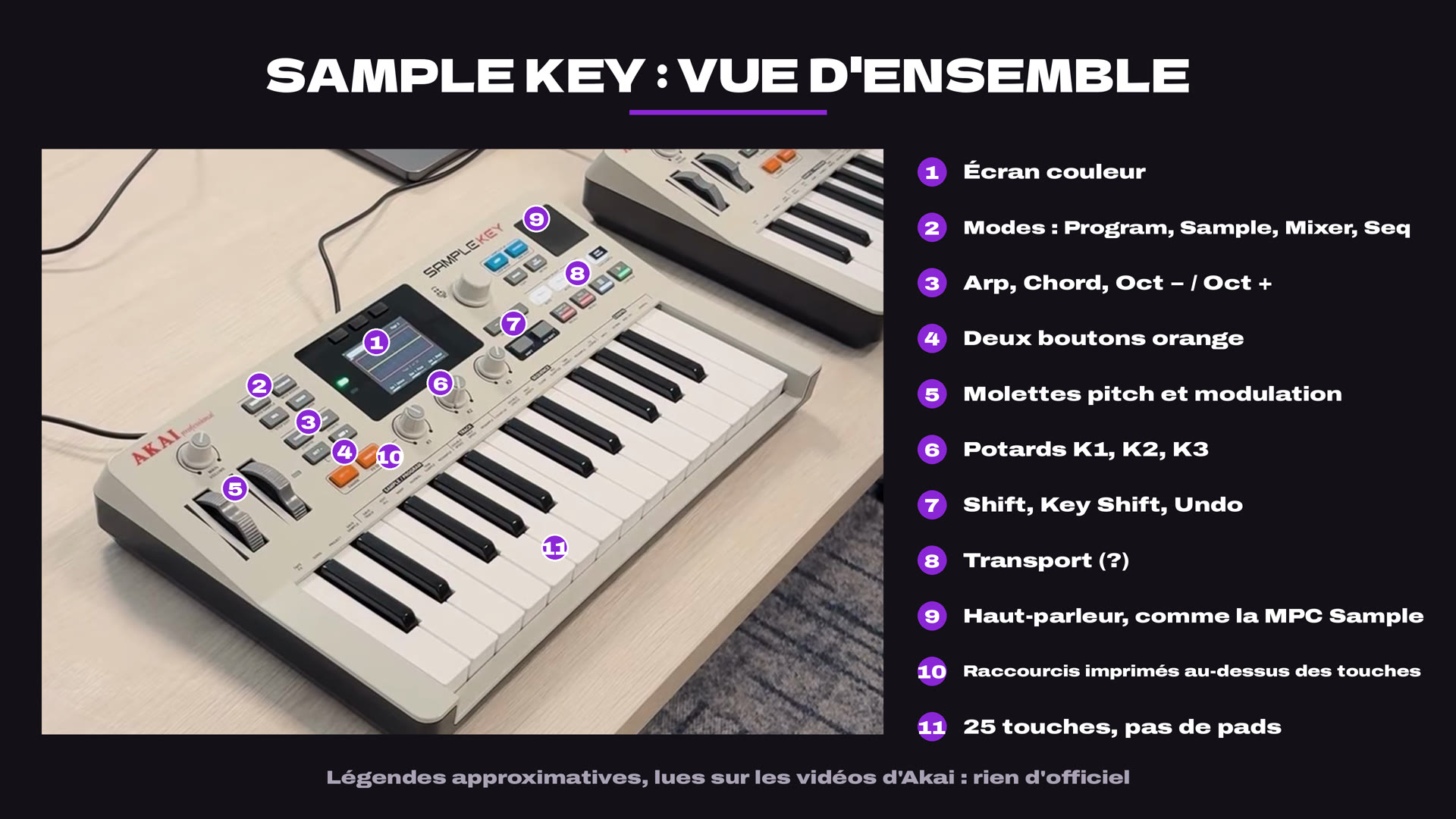
The day after Behringer’s announcement, Akai posted two videos on Instagram. Basically, the Sample Key is an MPC Sample where the 16 pads are gone, replaced by a 25-key keyboard.
Careful, it’s not a small MPC Key. The MPC Key 37 and 61 have a keyboard and pads. The Sample Key only has the keyboard. So no finger drumming: you play on the keys. There’s a pitch wheel, a modulation wheel and a built-in speaker like on the MPC Sample.
With the stock firmware, you can sample a different sound on each key, and the machine splits your keyboard into zones automatically. For me, it’s clear: it’s the same system as the MPC Sample. Same design, same screen, same knobs. The secondary functions of the pads move to the keys. Anything really tied to the pads, though, we won’t get.
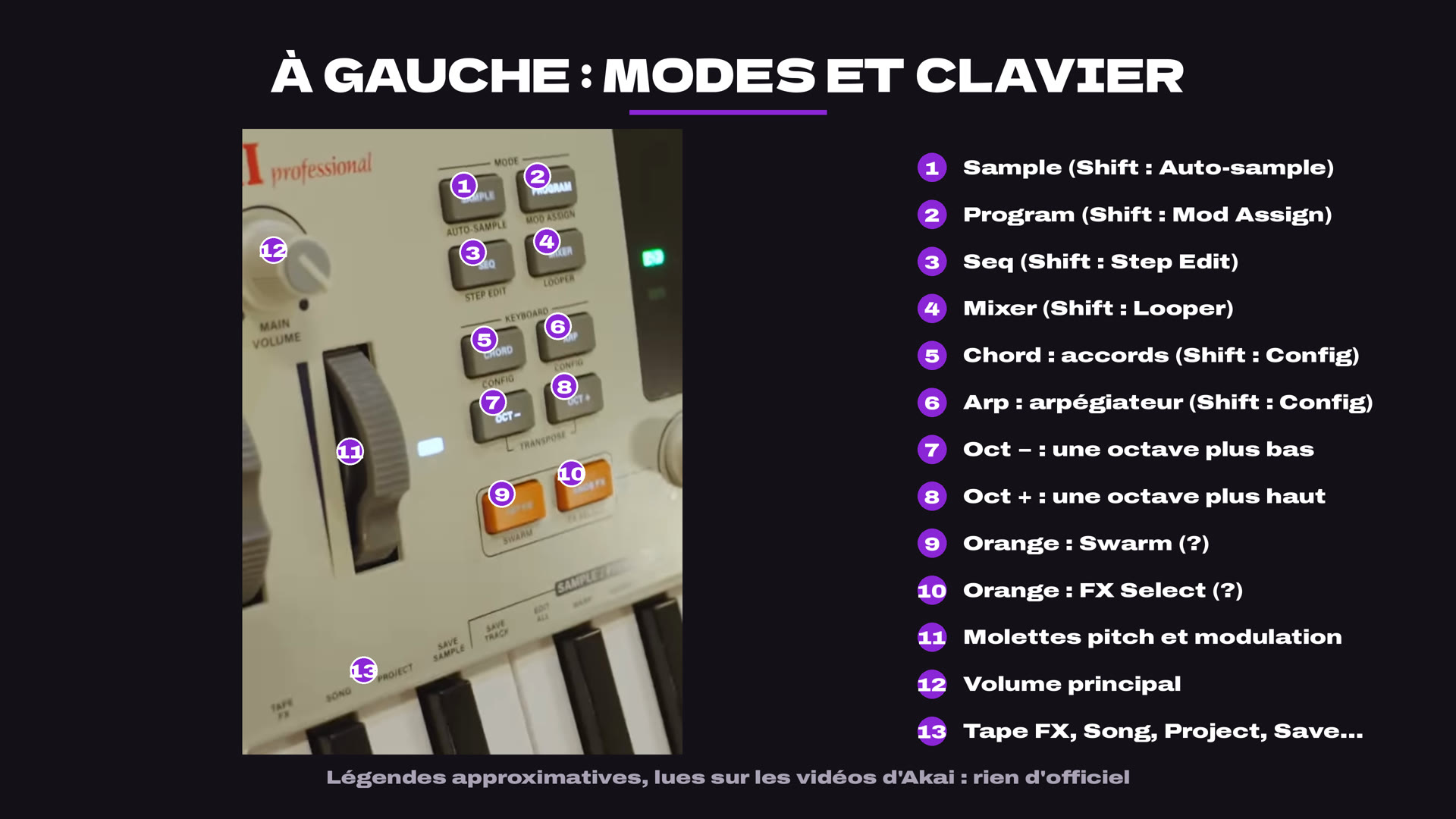
The Sample Key buttons on the left
I had fun zooming into the images from Akai’s videos to read the buttons. To be clear: this is my reading, not an official spec sheet.
- The Program, Samples, Mixer and Sequence modes
- Shift + Mixer: the Looper
- Shift + Sequence: Step Edit
- Sample starts auto-sampling
- An ARP button for the arpeggiator and a Chord button for chords
- Two buttons, Octave minus and Octave plus, which makes sense with only 25 keys
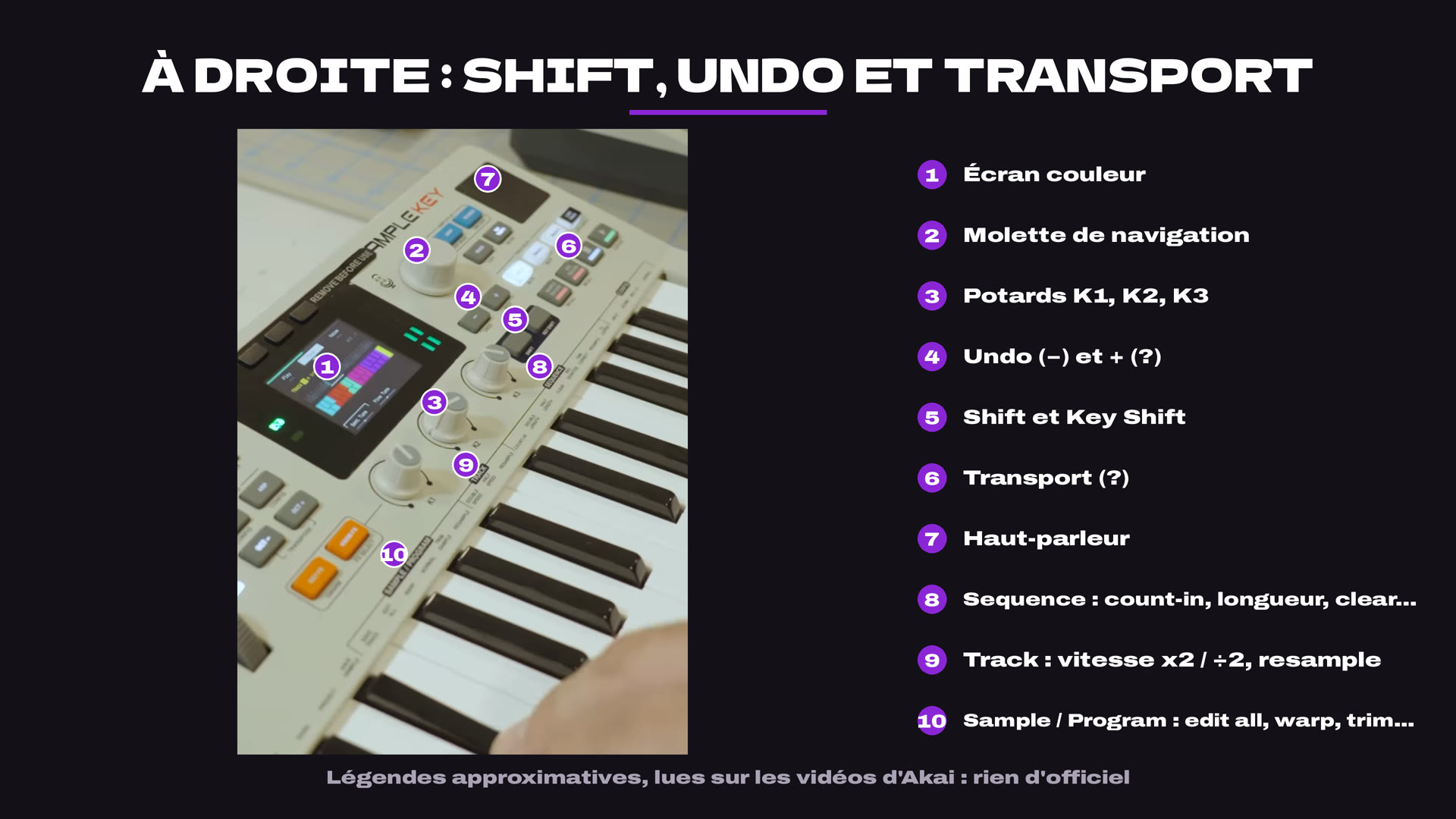
On the right: Shift, Key Shift and Undo
On the right, there’s Shift, something that looks like Key Shift (I’m not sure that’s really it) and Undo.
Another detail: in the video, the person presenting the machine holds their notes with a sustain pedal. So we’ll probably be able to plug one in.
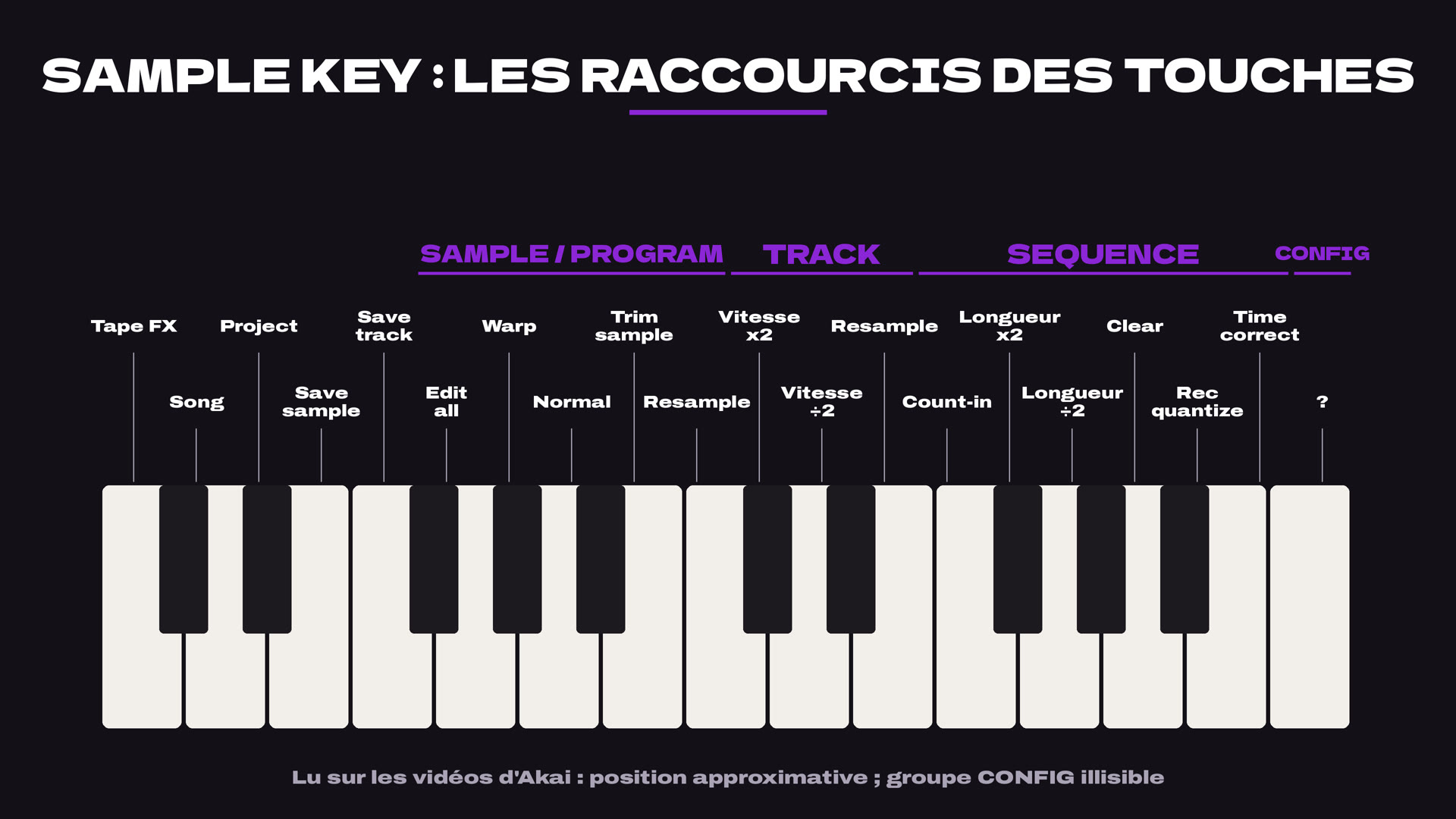
The shortcuts above the keys
Above the keys, there are printed functions, arranged in groups: Sample, Program, Track, Sequence and Config. Like on some master keyboards, the keys also work as shortcuts:
- Save your sample or your track
- Cut a sample, resample
- Double or halve the speed of a track (I think it’s the speed, I’m not sure)
- The count-in before recording
- Double or halve the length of a sequence, or clear it
Akai is betting on AI and the community
Akai says it clearly in its video: it’s going all in on the AI and vibe coding community. It’s the community that will decide what the machine becomes. To show it, they used Claude, Anthropic’s AI, to make an Omnichord-style chord machine (major, minor or seventh with the wheel, the keys replace the strip you brush), a polyphonic virtual analog synth with an oscilloscope, a bass, an FM synth, a wavetable, a chiptune synth and even a variant of Native Instruments’ Massive. Not a coincidence: Akai and Native Instruments belong to the same group, inMusic. Akai also announced it would make MPC samples available to the community.
Akai never mentions Behringer. But an announcement the next day on the same theme still looks a lot like a counterattack. Tinkerers are already modifying the MPC with unofficial firmwares: rather than putting up with the movement, Akai prefers to frame it.
Good news if you have an MPC Sample: I thought opening it up was a rumor, and it’s not. In its second video, Akai says the MPC Sample update is coming with the same community features, and the stock firmware will also get new features. No date, but it’s been said.
- True: the Kick exists as a prototype and its code really is public
- True: the Sample Key exists, Akai showed it itself, but with no price, no date and no spec sheet
- To be nuanced: Akai talks about opening the machine to the community, not about code published under a free license
What it changes for you, and my honest opinion
If you have an MPC, today: nothing. Your machine does exactly the same thing as yesterday, and for the MPC One, Live or XL, Akai hasn’t announced anything. The real question is whether Akai will also open the Live 3 and the XL. Nobody knows. Personally, I don’t really believe it: they need to keep selling their products, and they don’t want unstable machines flooding their support.
My honest opinion: for now, it’s mostly communication on both sides. A prototype on one side, a teaser on the other. But it’s genuinely good news if it pushes Akai to open up its machines. And as one YouTuber put it very well: Behringer can copy an MPC, but not the community around it. As soon as the MPC Sample update comes out, I’ll test it and show you what it looks like on the channel.
And you, would you buy the Kick at 150 dollars? Can you see yourself coding your own functions on your MPC? Tell me in the comments. Chase your dreams all the way!
Leave a Reply