
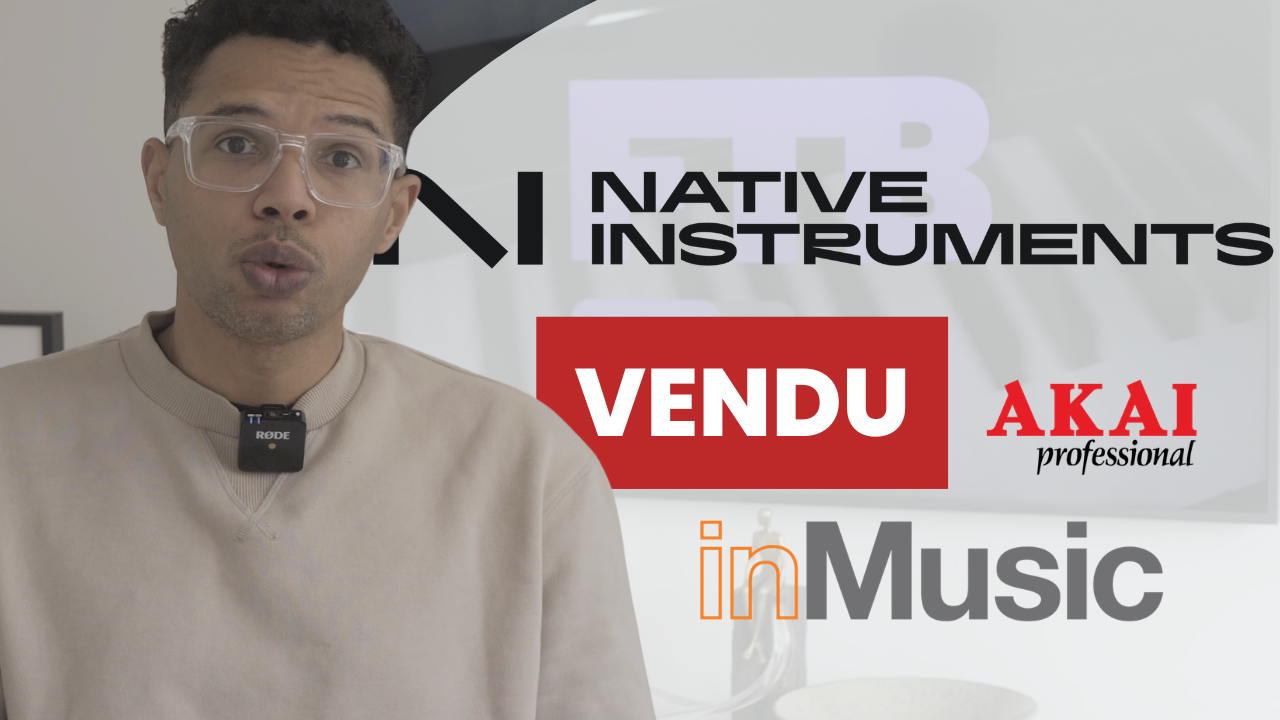
This morning I got an email as a Native Instruments developer partner. The announcement is official: Native Instruments has just been bought by inMusic, the parent company of Akai Professional, the parent company of the MPC.
I’m going to be honest with you. In my videos on Native Instruments plugins on MPC 3 and on NKS, I said this project had started several years ago and that there was something bigger behind it all. I didn’t have any inside info, I wasn’t in on the secret, and nobody could really have predicted it would be this big. But when you looked at the signs, the NKS partnership, the MPC Play Series plugins, inMusic’s strategy with AIR, the logic was obvious. I’d talked about it off the record with some of you in my courses or on French The Lab, but never officially. Today I’m lifting the veil.
Who Jack O’Donnell is and why this buyout is no surprise
To understand what’s happening, you have to understand who inMusic is and who Jack O’Donnell is. It all starts in 1992. O’Donnell is vice-president of sales at Stanton when he learns that the assets of the Numark brand are up for grabs. He buys, he turns it around, the brand survives and grows. That’s the start of inMusic.
The playbook behind it all is always the same: he spots an iconic brand in trouble, he buys it, he keeps the brand’s identity intact and he manages it for the long term. It’s debatable, not everyone necessarily agrees, but that’s how it goes. Alesis goes bankrupt in 2001, he buys it. Akai Professional in trouble in 2005, he buys it. Our MPC is him. Moog with supply chain problems in 2023, he buys it. And every time the brands keep existing, releasing products, living.
And in 2012 he also buys M-Audio and the AIR Software Group from Avid. That’s where it all makes sense for us MPC users.
If you’ve followed the Native Instruments news, two investment funds, Bridgepoint and Bain Capital, had looked at NI’s mountain of debt: 250 million pounds of debt for 25 million in annual revenue. They said no thanks and pulled out in early 2026, triggering the bankruptcy filing. O’Donnell, on the other hand, saw an opportunity. Because that’s been his job for 30 years. He doesn’t buy to resell in 5 years. He buys to build.
The AIR story: the model that explains everything
AIR was a company that developed plugins for Pro Tools at Avid. That’s actually how I discovered AIR, using Pro Tools, which was my tool of choice back then. inMusic buys AIR for 17 million dollars along with M-Audio in 2012, and what happens next?
Update after update, plugin after plugin, all the instruments we have today on the MPC’s touchscreen arrive. The Mellotron, the Odyssey, the Fabric XL, the TubeSynth, the Vintage Memorymoog, the Vintage Jup, the Studio Strings, the DrumSynth, the OPx-4. All of that is AIR. All of that is inMusic. Right on our machine, no computer, no external VST.
The model is simple: inMusic buys a quality software company and gradually its instruments end up native in the MPC. It’s not a theory, it’s what we’ve been living for several years.
The signs I had seen
In my video on NI plugins on MPC 3, I said clearly that this project had started several years ago. In my video on the MPK and NKS, I said there was something bigger behind it all.
I also did a video on my disappointment with MPK/NKS, because the announced integration was more marketing than real integration. The MPK Mini Play and MPK Mini Plus, for example, were just 8 knobs to control parameters, no preset browsing, no screen, no real NKS experience. I said so clearly.
But the really interesting part of this collaboration was the MPC Play Series. Five Native Instruments instruments built right into MPC 3 with a Native Instruments interface on the touchscreen. That was a real revolution for MPC users and it laid the foundation for what’s happening today. And it even coincides with the start of this channel, since I began with videos on these plugins.
What it could actually change for your MPC
Let’s be honest. I’m not going to promise you Kontakt standalone on MPC tomorrow morning. But inMusic’s history with AIR shows us that it gets built gradually, update after update.
What’s realistic in the short term is more plugins in the spirit of the MPC Play Series, but this time with all of Native Instruments’ assets behind them. NI instruments optimised for the touchscreen. It’s the natural path, continuing what already exists.
The real open question is Maschine standalone. Today it’s a machine looking for its place next to the MPC. Either it completely reinvents itself with a new identity, or it evolves into something else. I don’t know. But for those who were crying about not having native Kontakt on their MPC, this news reopens the conversation and makes the possibilities a bit more concrete.
For the first time, all the ingredients are under the same roof. And that’s something promising for the future.
Which Native Instruments plugin would you like to see on your MPC first? Tell me in the comments, and we’re discussing it on French The Lab too.
Chase your dreams all the way!.
Leave a Reply